
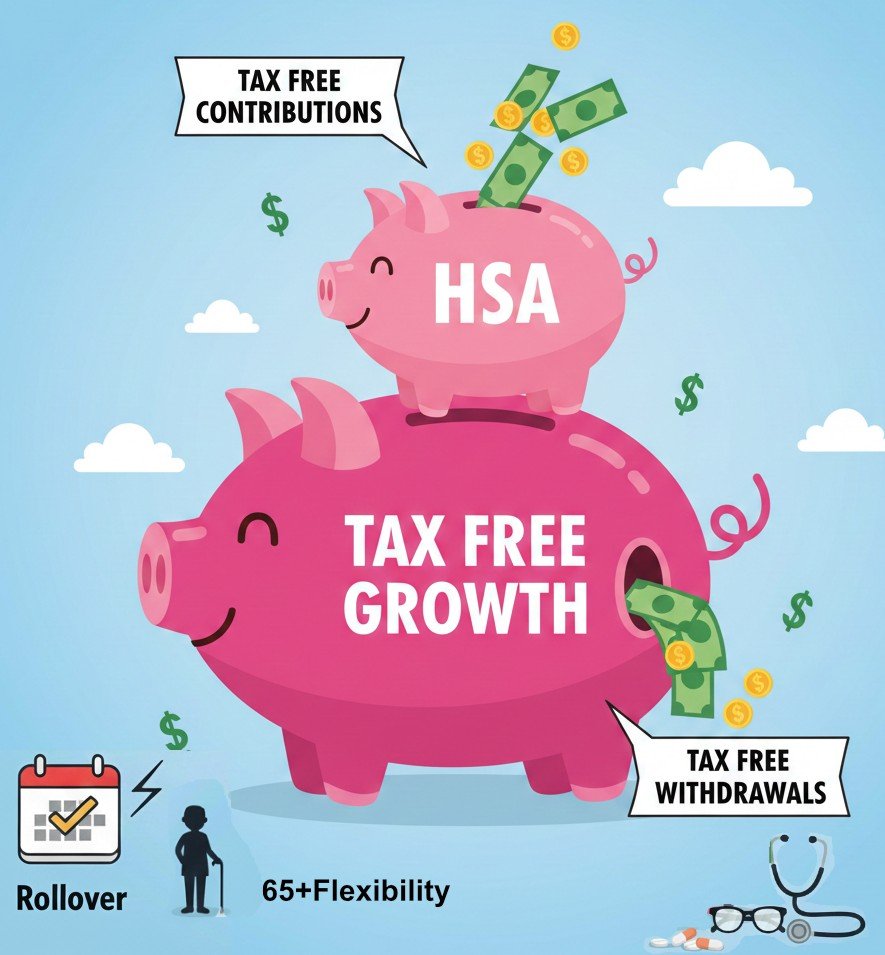
HSA has been around since 2004 and its triple tax benefits are well known, but sometimes overlooked as a retirement strategy. Here is an overview of its advantages:
- You can contribute pre-tax dollars which lowers your taxable income. (Tax Deductible Contributions)
- You do not need to pay taxes on earnings while the assets remain in your HSA. (Tax Deferred Growth)
- When you pay for qualified medical expenses from your HSA, withdrawals are tax-free and can be made at any time without penalty. (Tax Free Withdrawals) BE AWARE, if you use HSA funds to pay for non-qualified expenses, the money will be included in your gross income for tax purposes and you will be subject to an additional 20% penalty.
Some added benefits for the HSA accounts:
- HSA is portable (which means it is yours even if your employer sponsored the health plan and contributed to it), and the fund can roll over from year to year and never expires (unlike the FSA account that has a “use it or lose it” rule).
- Once you reach age 65, you can use HSA dollars for anything you’d like WITHOUT PENALTY. Any withdrawals that aren’t used for qualified medical expenses will be taxed as ordinary income, like most withdrawals from traditional IRAs.
OBBB expanded eligibility for HSA:
Effective January 1, 2026, the OBBB reclassifies Bronze and Catastrophic ACA Marketplace plans as qualifying High-Deductible Health Plans (HDHPs), enabling millions more enrollees to open and contribute to HSAs. Prior to OBBB, only some HDHPs are considered HSA eligible plans and Catastrophic plans are not eligible for HSA. IRS Notice 2026-05 clarifies that bronze and catastrophic plans do not have to be purchased through an exchange to qualify for the new relief.